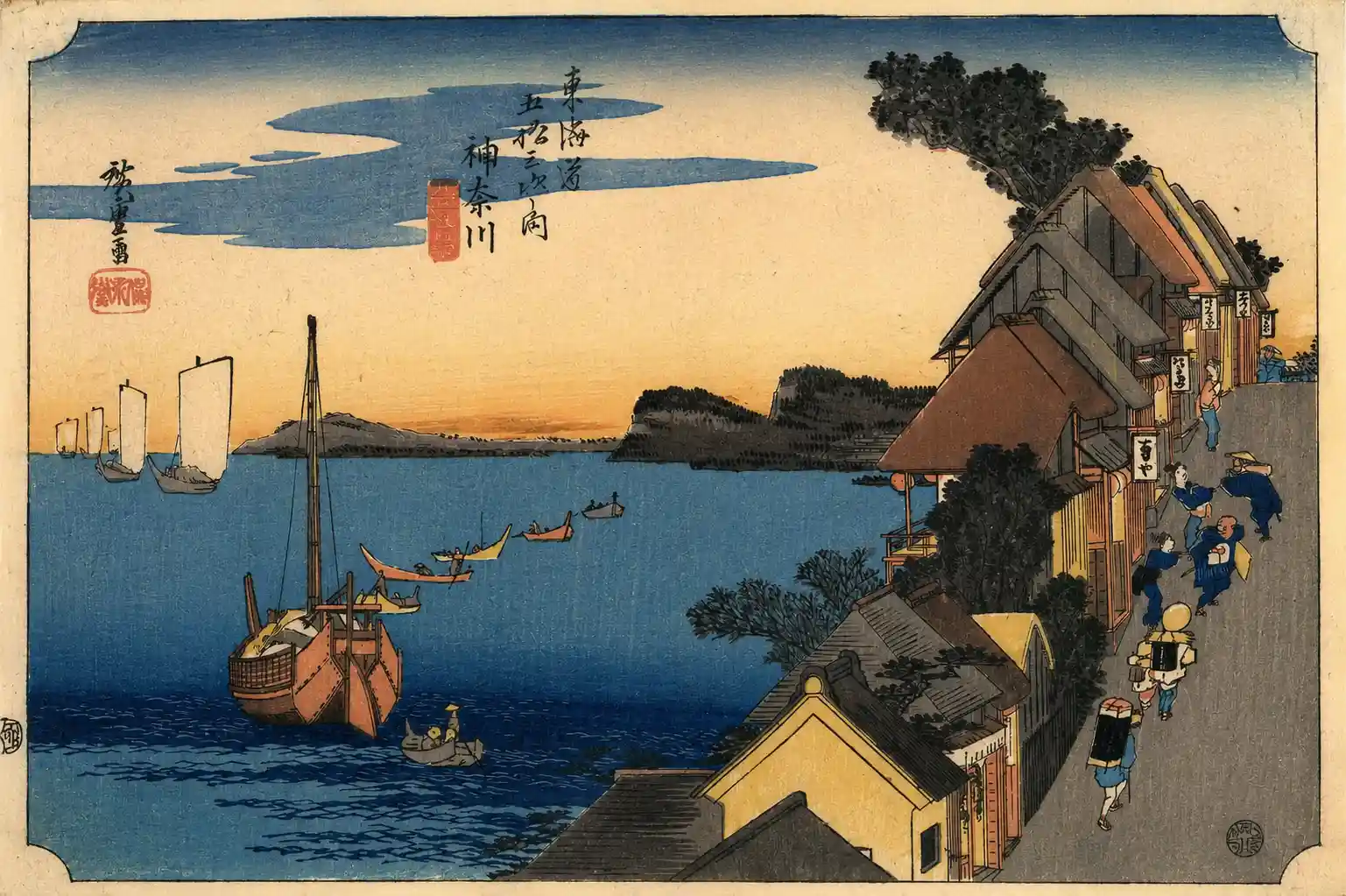
The tide is withdrawing.
A pale blue still lingers above the water of Kanagawa, where the boats return slowly toward the harbor, carrying salt, silence, and the weight of the open sea.
The slope is steep.
Porters lower their heads as straw sandals scrape against the dry road. Some carry baskets of fish. Others hurry home before darkness settles over the coast. Lamps are already glowing inside the inns above the hill, their paper windows breathing a faint amber warmth into the cold evening air.
Wind rises from the bay.
It moves through cedar branches and wooden roofs with the smell of wet rope and distant rain.
The white sails offshore do not move.
They remain there like fragments left behind by another world. No voices drift across the water now. Only the soft knocking of wood against wood inside the harbor.
This road along the Tōkaidō never truly sleeps.
Samurai, merchants, actors, pilgrims, fugitives —
all of them pass through this slope on their way to Edo, or away from it.
But when evening comes, people become quieter.
Because the sea begins to darken.
And night in Kanagawa always arrives earlier than expected.
A woman beneath the eaves folds her hands into her sleeves and turns once toward the harbor.
Soon the water will disappear into shadow.
Then only scattered lights will remain.
And after that —
only wind.
***
They say this slope was where many travelers first sensed the breath of Edo.
In Hiroshige’s \*Kanagawa\*, the harbor is not merely a landscape.
It is the final pause before the vast city swallows the traveler whole.
Along the Tōkaidō, countless footsteps crossed this road every day.
Some walked toward ambition.
Others walked away from failure.
The sea answered none of them.
People in Edo loved such scenes.
Because they understood something simple:
The floating world was never only about pleasure.
Its true shape appeared after the lanterns were lit —
when loneliness quietly entered with the evening tide.