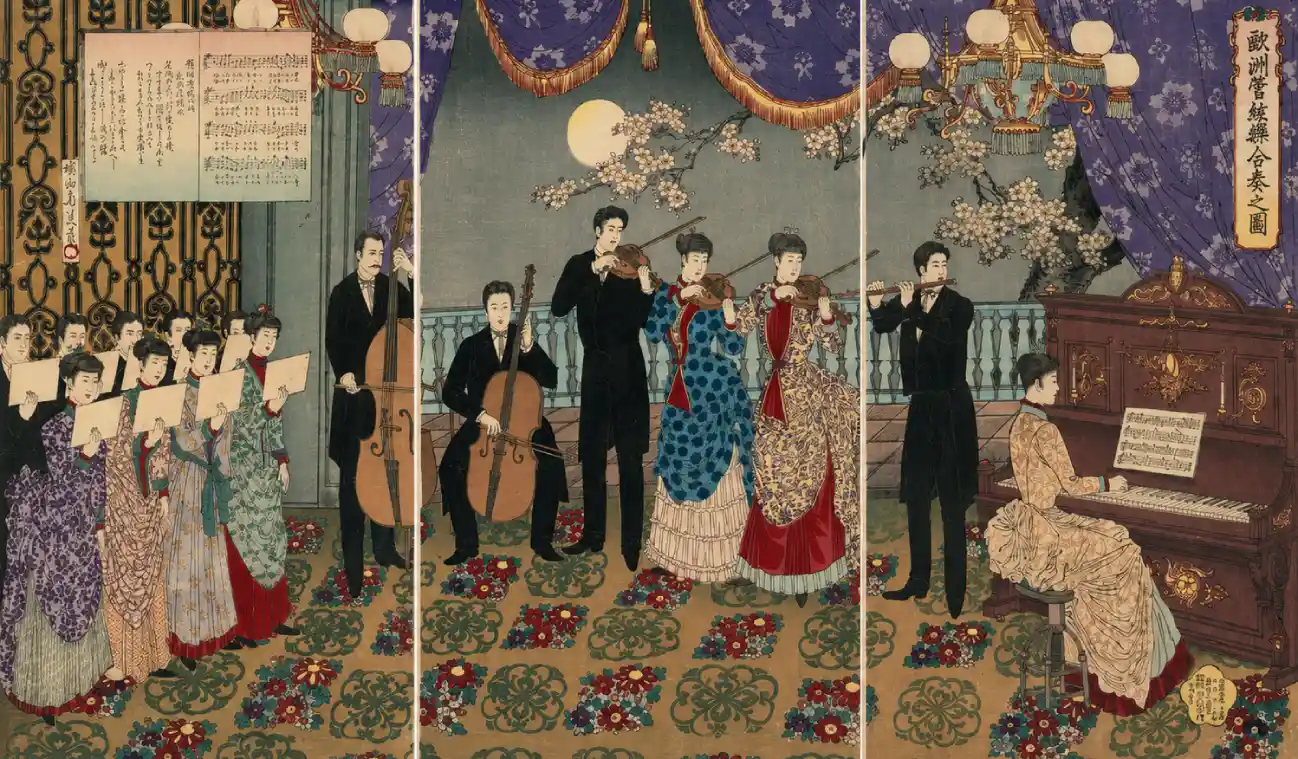
The moon lingered behind violet velvet curtains.
Inside the glass lamps, the fire breathed softly.
Women in layered dresses stood motionless, their skirts spreading across the carpet like flowers soaked in midnight rain.
Someone unfolded the sheet music.
The paper whispered.
Then the first note arrived.
A violin trembled through the room beneath chandeliers and gold ornament.
The piano moved slowly, like a black steamship entering Yokohama harbor through fog.
For those who had only known shamisen and taiko drums,
this was the first time they understood—
music could fill a room like weather.
Outside, the cherry blossoms were falling.
Petals drifted across the balcony and settled between kimono sleeves and Western coats.
No one touched them.
Because everyone was watching another world arrive.
The girls did not truly understand Western harmony.
They had simply been carried into it by the tide of the era.
Civilization. Enlightenment.
In early Meiji Japan, those words smelled of coal smoke and seawater.
Steamships gathered in the ports.
Gas lamps appeared in the streets.
Glass glittered in the shops of Ginza.
And the ukiyo-e artists carved this unfamiliar future into woodblocks as fast as they could.
That is why the scene feels strange.
The women wear European dresses,
yet still stand with the quiet restraint of Edo bijin-ga.
They play foreign instruments,
yet their eyes still belong to the lantern districts of old Japan.
Even the velvet curtains do not feel entirely Western.
They feel like Japan dreaming about the West.
The true fear was never the black ships.
It was the sudden realization—
the world was larger than Edo.
***
After Yokohama opened to foreign trade, many ukiyo-e artists encountered Western instruments for the first time.
They did not fully understand perspective.
Nor the structure of orchestral music.
So they copied what they saw,
and imagined the rest.
These prints later became known as \*Yokohama-e\*.
Foreigners looked slightly unreal.
Buildings resembled theater stages.
Light itself seemed uncertain inside the limits of woodblock printing.
Yet that uncertainty became their beauty.
Because within those imperfect lines survives the emotion of an isolated country hearing the sound of the outside world for the very first time.
Quiet wonder.
And quiet fear.