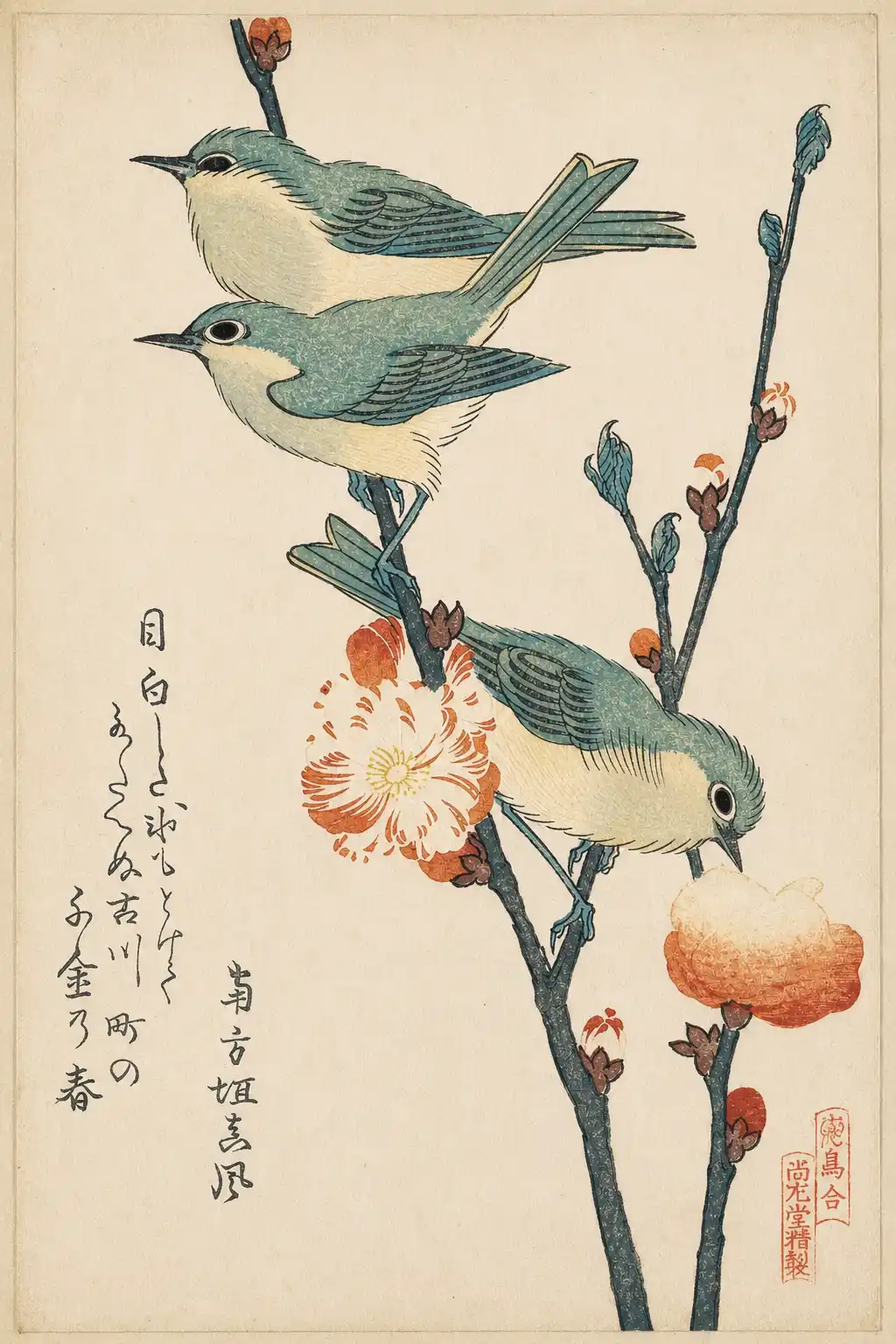
The three birds remained strangely still.
Not singing.
Waiting.
The lowest one tilted its head toward a blossom that had not fallen yet. Its feathers carried the faint blue-green of morning fog above river water. The carved woodblock lines still lingered within the wings, as though the knife marks of the artisan had never completely disappeared.
The room behind the window was silent.
Only the faint sound of pages turning.
A woman sat beside a dim lamp, smoothing the edge of a folded letter with her fingertips. The ink had dried yesterday, but the fragrance remained. She refused to unfold it again. Some words become heavier after the second reading.
Outside, one of the birds shifted slightly.
A plum petal fell.
There was no wind.
Only the distant temple bell crossing the damp night air.
Spring was near.
But people in Edo understood something well:
the coldest nights were never the snowy ones.
They arrived just before the flowers opened.
A season suspended between departure and return.
As if someone were finally coming home.
Or perhaps—
never returning at all.
***
People of Edo loved plum blossoms and small birds for a reason.
Plum flowers bloom before warmth arrives.
They belong to unfinished spring.
To longing.
Flower-and-bird prints were never merely decoration. Merchants, widows, actors, and wandering poets hung them inside narrow wooden rooms to soften the silence of winter evenings.
The painters understood this.
People were not truly looking at birds.
They were looking at waiting itself.
An old saying whispered through Edo teahouses claimed that if white-eye birds gathered on plum branches during a rainy night, spring was already crossing the city unseen.
But nobody knew whether it carried reunion—
or farewell.