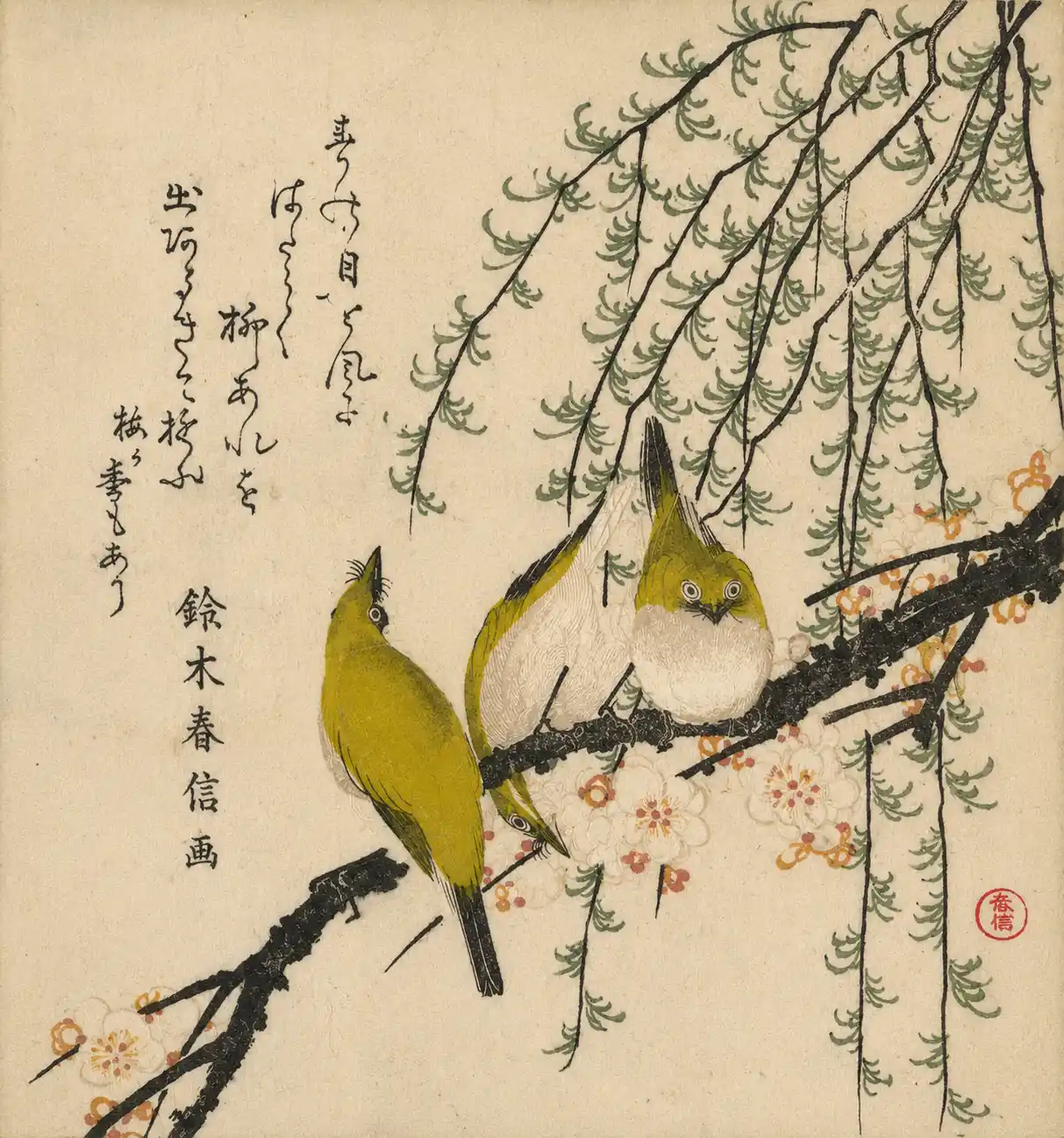
Two small green birds rested upon the branch.
They looked as though they had been waiting there for years.
One tilted its head slightly, its dark eye reflecting the pale sky. The other buried itself inside soft feathers, resisting the final cold hidden inside early spring. Whenever the wind passed, the willow leaves brushed gently behind them with the faintest whisper.
People in Edo believed spring was the season when the dead returned quietly to the heart.
Especially beneath willow trees.
Because willow branches remembered the direction of every passing wind.
The teahouse nearby had already sent away its final guests. Women closed the paper doors one after another, turning lantern light into blurred amber shadows. Someone coughed softly upstairs. Someone gathered empty sake cups. Someone simply watched the river in silence.
Nobody spoke.
Spring nights were too fragile.
A single word might disturb the stillness of the entire river.
One of the birds trembled suddenly.
Only slightly.
Like hearing a forgotten name inside a dream.
Then silence again.
Only the plum blossoms continued to fall.
One petal.
Then another.
Drifting into a night from two hundred years ago that never truly ended.
***
It is said the people of Edo loved paintings of spring birds and hanging willow branches.
Not because spring was joyful.
But because that moment — when warmth begins to arrive while winter still lingers underneath — resembled the human heart.
These bird-and-flower prints became beloved during the late Edo period. They hung inside teahouses, studies, and narrow wooden rooms. In daylight they felt elegant. But after midnight, they carried an unspoken loneliness.
Some believed the true subject of those prints was never the bird itself.
But the air of Edo nights.
When lanterns faded and mist rose from the river, even the willow branches seemed to grow old in silence.