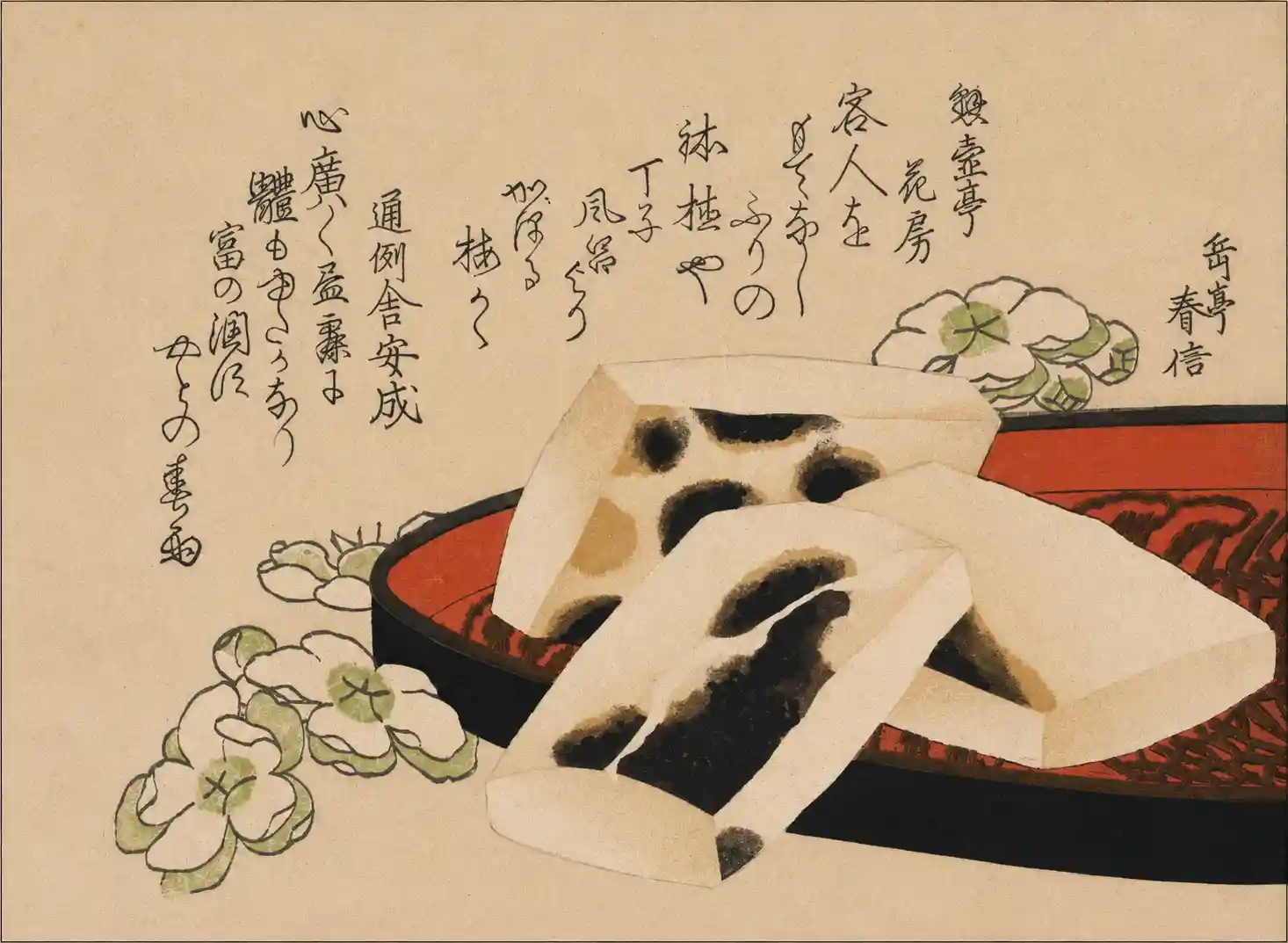
Behind the paper screen, lantern light softened the pale sweetness of the confection until it looked almost damp — like slices of snow left too long in a warm room.
In the lacquer tray, dark beans rested inside translucent jelly like pieces of charcoal still breathing beneath ash.
The scent of flowers lingered quietly.
Not the bright fragrance of a garden, but the fading perfume caught in the sleeve of a woman returning late through the alleys of Edo.
Outside, someone crossed the wooden bridge.
Wet geta sandals tapped softly against the rain-dark boards.
Inside the teahouse, no one spoke.
Only the brush moved.
A poem had just been finished.
The ink still glistened faintly, the calligraphy leaning downward like the voice of someone reciting verses after too much sake.
These were not poems for nobles.
Only for tonight.
The sweets had been cut with care.
Yet one corner had already collapsed slightly, as though someone, unable to resist the loneliness of the hour, had taken the first bite before the guests arrived.
People of Edo were often like that.
Even in their elegance, hunger remained close —
not merely for food,
but for warmth, company, and the fragile beauty of passing seasons.
The white blossoms beside the tray felt unnaturally still.
As if the entire room understood something no one wished to say aloud:
spring never stays very long.
***
In the late Edo period, artists and poets often painted sweets, flowers, and small seasonal objects not as decoration, but as vessels for atmosphere.
The floating world was not only found in famous courtesans or grand kabuki stages.
Sometimes it lived in quieter things:
a midnight snack,
a rain-soaked teahouse,
a poem written before dawn.
By then, merchant culture had transformed Edo into a city where ordinary people pursued fleeting beauty with remarkable devotion.
Tea, incense, seasonal confectionery, and poetry became small rituals against the impermanence of life.
Some old storytellers used to say:
the true heart of Edo was never the battlefield.
It was the silence after midnight —
when the rain continued outside,
and someone sat alone beside a lacquer tray,
watching spring disappear one drop at a time.