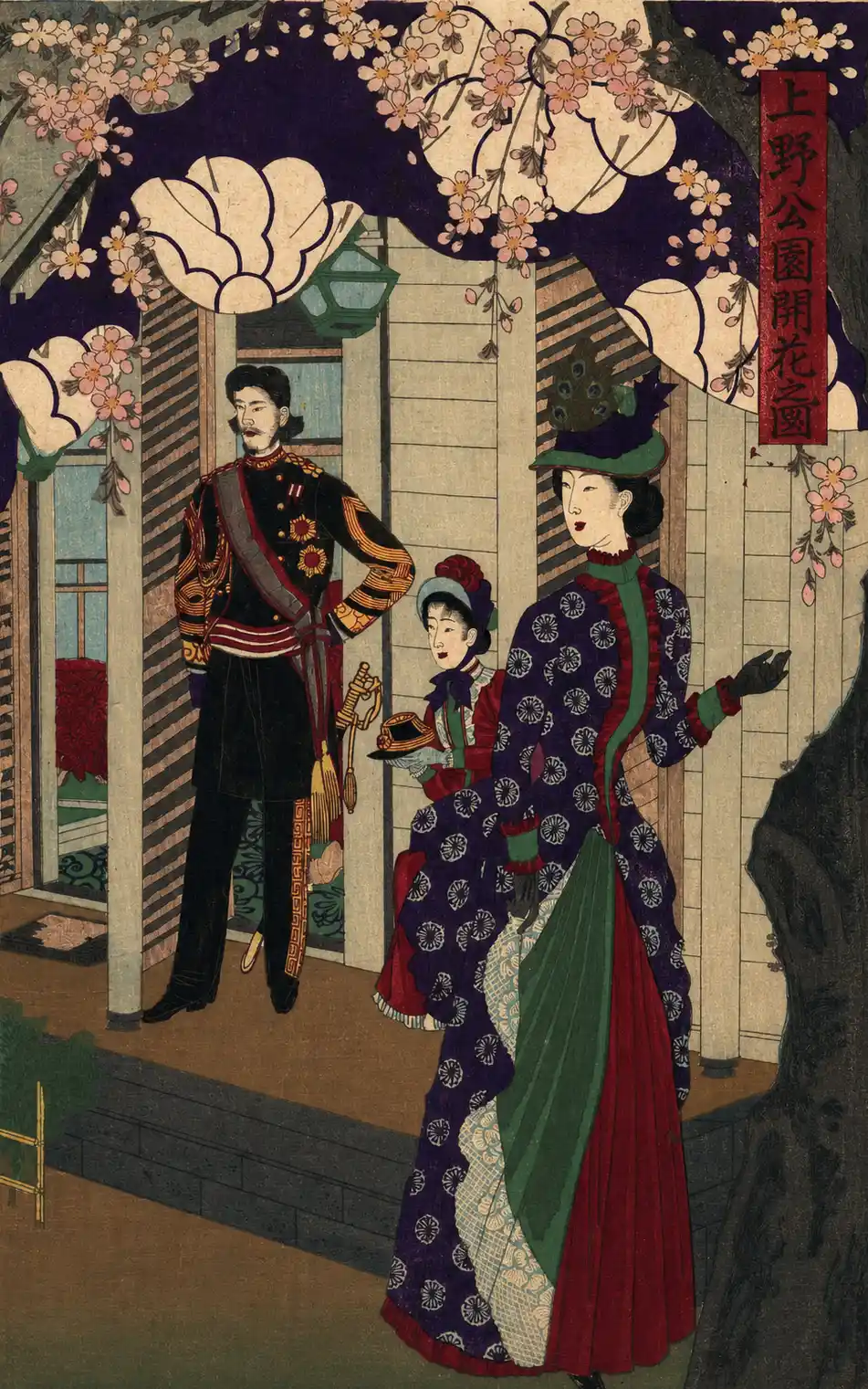
The cherry blossoms had not fully opened yet.
But the night had already settled into the cracks of the Western house.
The woman stood at the entrance without turning back.
Her deep indigo coat hung heavily around her shoulders, like she had wrapped the entire spring evening around herself. Only the red lining beneath remained vivid — dangerously vivid — against the dim air.
Behind her, the man in military uniform watched in silence.
Gold embroidery shimmered beneath the oil lamp.
Not the clothing of a samurai.
Something imported.
Something from a different century.
The air of Meiji had already begun to smell of iron.
Inside the house, a young girl carried a tray of tea carefully enough to silence even her own breathing. She did not understand politics, nor empires, nor black ships.
She only knew the streets had changed.
Too many men now wore boots instead of swords.
And somehow, that felt worse.
Above them, cherry branches flooded the sky.
Soft petals drifted across a violet darkness so deep it almost resembled wet ink. The blossoms looked fragile enough to disappear with a single gust of wind.
Like the final spring of Edo itself.
The woman lifted her fingers slightly.
A gesture so small it could have meant farewell.
Or hesitation.
Or the quiet fear that the wind no longer belonged to the old world.
Somewhere far away, wheels echoed through the night.
No horses.
Only civilization.
The wooden Western-style building carried the scent of damp timber and fresh paint, while traces of old paper screens still lingered underneath.
Two eras stitched uneasily together.
Like skin trying not to tear apart.
And still, the blossoms continued to fall.
Years later, people would call these images \*Yokohama-e\*.
But perhaps those who first saw them never thought of them as art.
Perhaps they were simply standing at the harbor, staring silently at the smoke of black ships rising into the sky—
realizing too late
that another world had already arrived.
***
It is said that after Yokohama opened to the world, people were not most fascinated by foreigners.
They were fascinated by what Japan itself was becoming.
Western dresses.
Oil lamps.
Military medals.
Brick buildings.
Every new object felt slightly unreal.
That is why Yokohama-e carries such a strange loneliness beneath its bright colors.
The prints are filled with excitement—
but also with the unease of a country hearing the future approach before it can understand it.
Some believed the first thing civilization erased was not the samurai.
But darkness itself.
Because once the oil lamps were lit,
the shadows of old Edo no longer had anywhere left to hide.