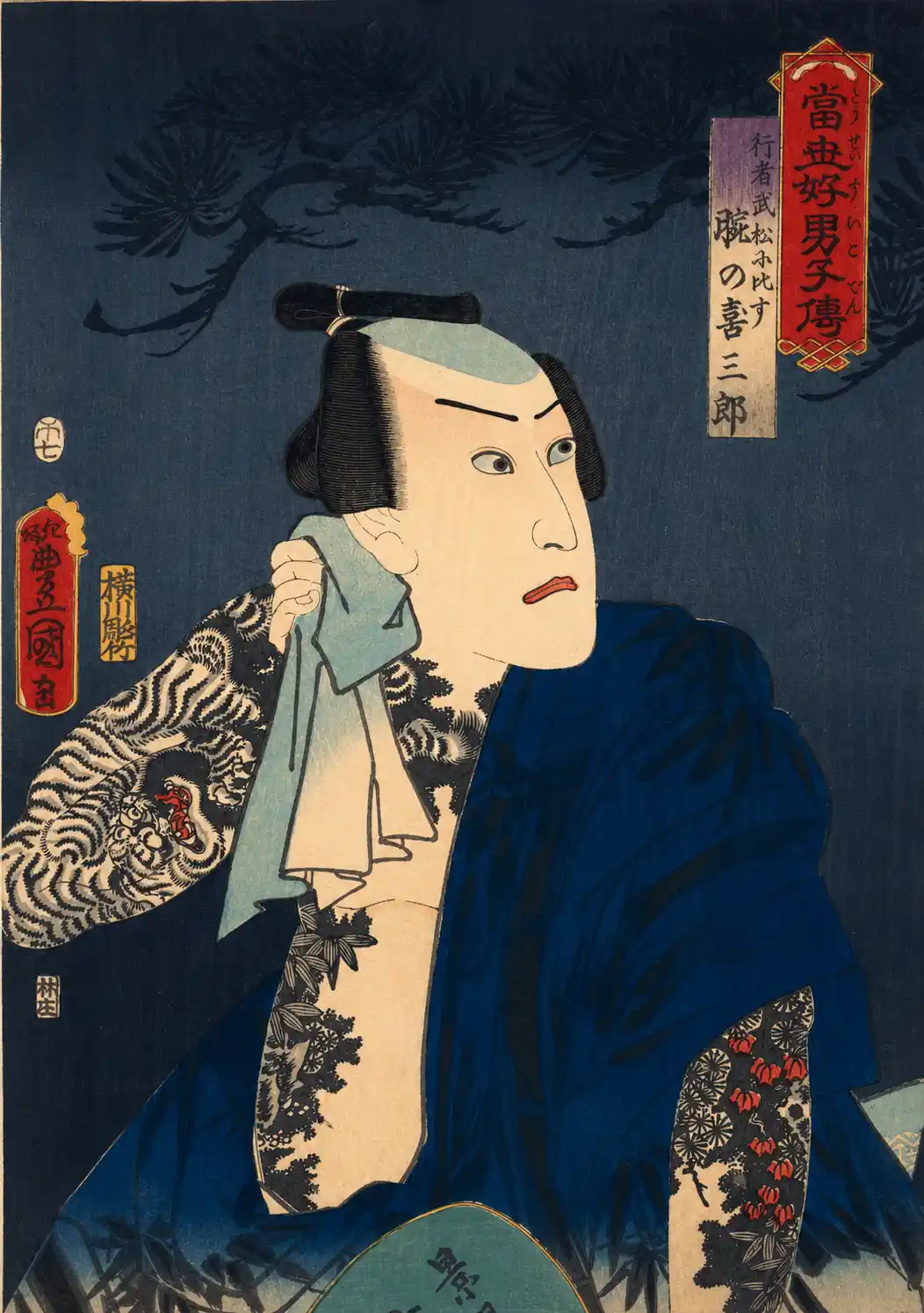
The night hung low like wet ink above the roofs of Edo.
Pine branches trembled in the dark.
There was no wind,
yet the needles whispered endlessly.
The actor had stopped walking.
His blue robe still carried the warmth of sweat,
as if he had only just stepped away from a stage duel.
The lantern light reached his face,
but not his back.
That pale skin was not the pale skin of ordinary men.
It belonged to the theater.
A white face meant for watching death.
Slowly,
he lifted a cloth to his neck.
Not wiping.
Listening.
As though someone behind him
had spoken without sound.
Edo nights were never silent.
Far away:
shamisen strings,
drunken laughter leaking through wooden lattice windows,
sandals splashing through rainwater,
a broken folk song wandering the alleyways.
Yet inside this print,
everything suddenly stops.
Because of those eyes.
He is not looking at us.
He is looking toward something
that should not exist.
The tattoos beneath his sleeve crawl like shadows under skin —
flowers,
beasts,
darkness blooming from flesh itself.
The people of Edo loved such things.
The deeper they were hidden,
the more truthful they felt.
Light slips across his jaw.
For a breath,
his face becomes a Noh mask.
Frozen.
As if in the next moment,
he might draw a blade.
But the print ends here.
Forever before violence.
The people of Edo did not love victory.
They loved the silence
just before the human heart collapsed.
***
It is said that after the fall of the shogunate,
these actor prints slowly vanished.
Because the real drama had already begun.
Samurai lost the right to carry swords,
and the heroes of kabuki became ghosts of another age.
But to the townspeople of Edo,
actors were never merely performers.
They were borrowed dreams.
Especially in these exaggerated portrait prints,
where artists carved obsession directly into wood:
the sharpened brows,
the strained mouth,
the eyes holding back catastrophe.
Not realism.
Something far more dangerous.
Emotion made permanent.
Some old storytellers claimed
the nights of late Edo were louder than any Hyakki Yagyō.
Because by then,
the true monsters already lived inside people.