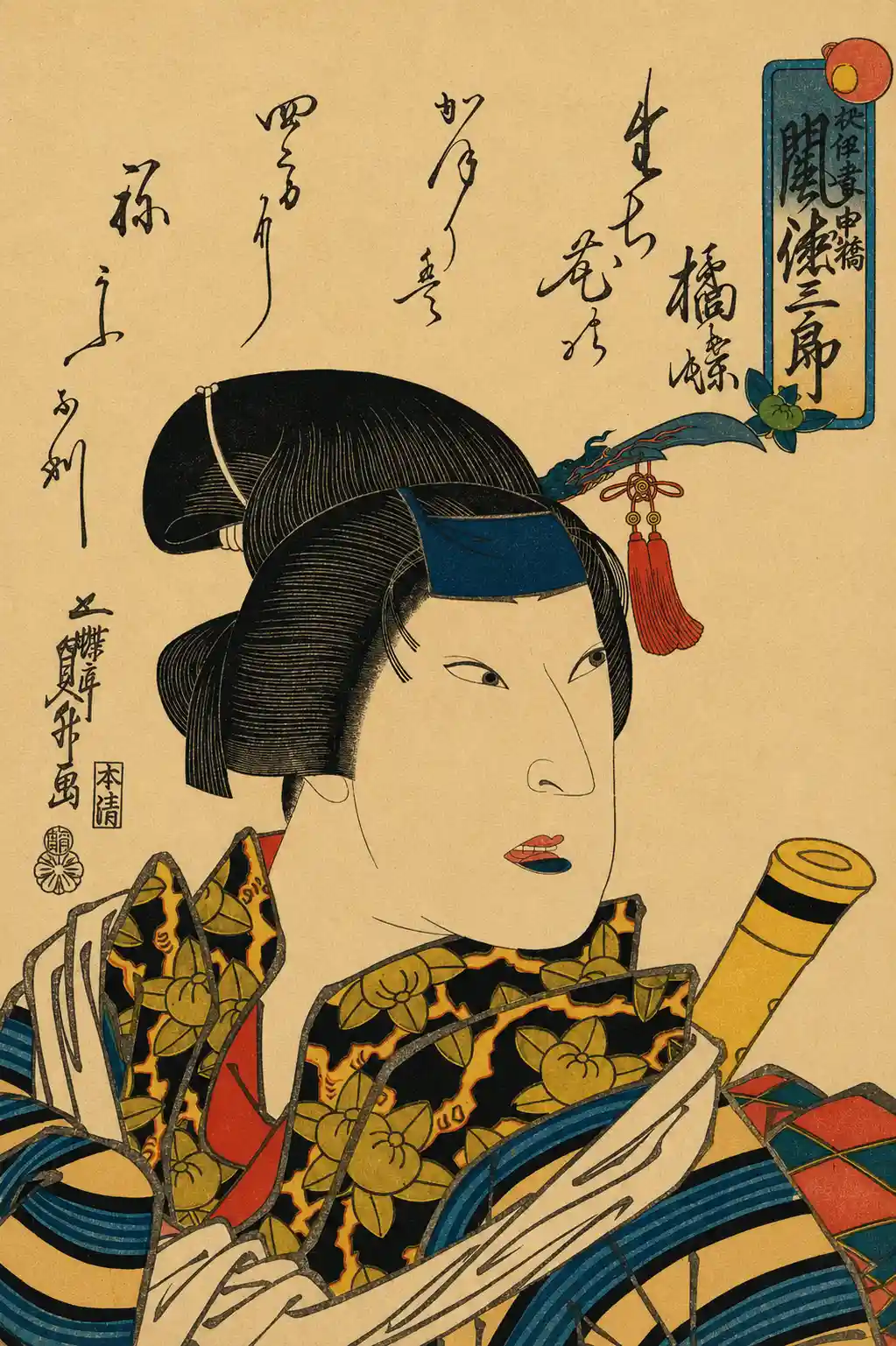
She did not turn.
Her hair, lacquer-black and heavy with camellia oil, curved like midnight itself beneath the faint glow of lantern light. A strip of deep indigo cloth rested across her forehead, while her eyes — narrow, distant, almost cutting — seemed fixed on something no one else in the room could see.
The crimson tassel beside her hairpin trembled softly.
You could almost hear it brushing against silk.
Her kimono was layered with dark gold flowers and restless blue waves, patterns dense as storm clouds over winter water. A folded paper slipped from her sleeve like an unfinished farewell letter. Or perhaps a confession never meant to be read.
The lipstick on her mouth remained incomplete.
As if she had stopped halfway through preparing herself for the night.
Below the teahouse, someone might have been waiting.
Or perhaps no one was.
From somewhere across the district came the fading sound of a shamisen. In Yoshiwara, noise never truly reached the heart of a person. Laughter drifted like smoke beyond paper doors, while loneliness settled quietly into the grain of the wood itself.
Her expression carried neither fear nor tenderness.
Only resolve.
The empty space around her is vast.
So vast that the silence itself becomes part of the portrait.
You begin to hear things hidden inside the paper —
the distant echo of geta on wet stone,
the soft crackle of lantern flame nearing extinction,
the unbearable weight of things left unsaid.
***
This style belongs to the world of Edo-period actor prints, where faces were never painted as simple likenesses.
The exaggerated lines, the sharpened gaze, the tension frozen inside stillness — these were meant to capture not the actor alone, but the emotion of a role at the exact moment before fate collapses.
People in Edo often hung such prints inside narrow wooden homes lit only by oil lamps.
By daylight, they were portraits.
At night, they almost became visitors.