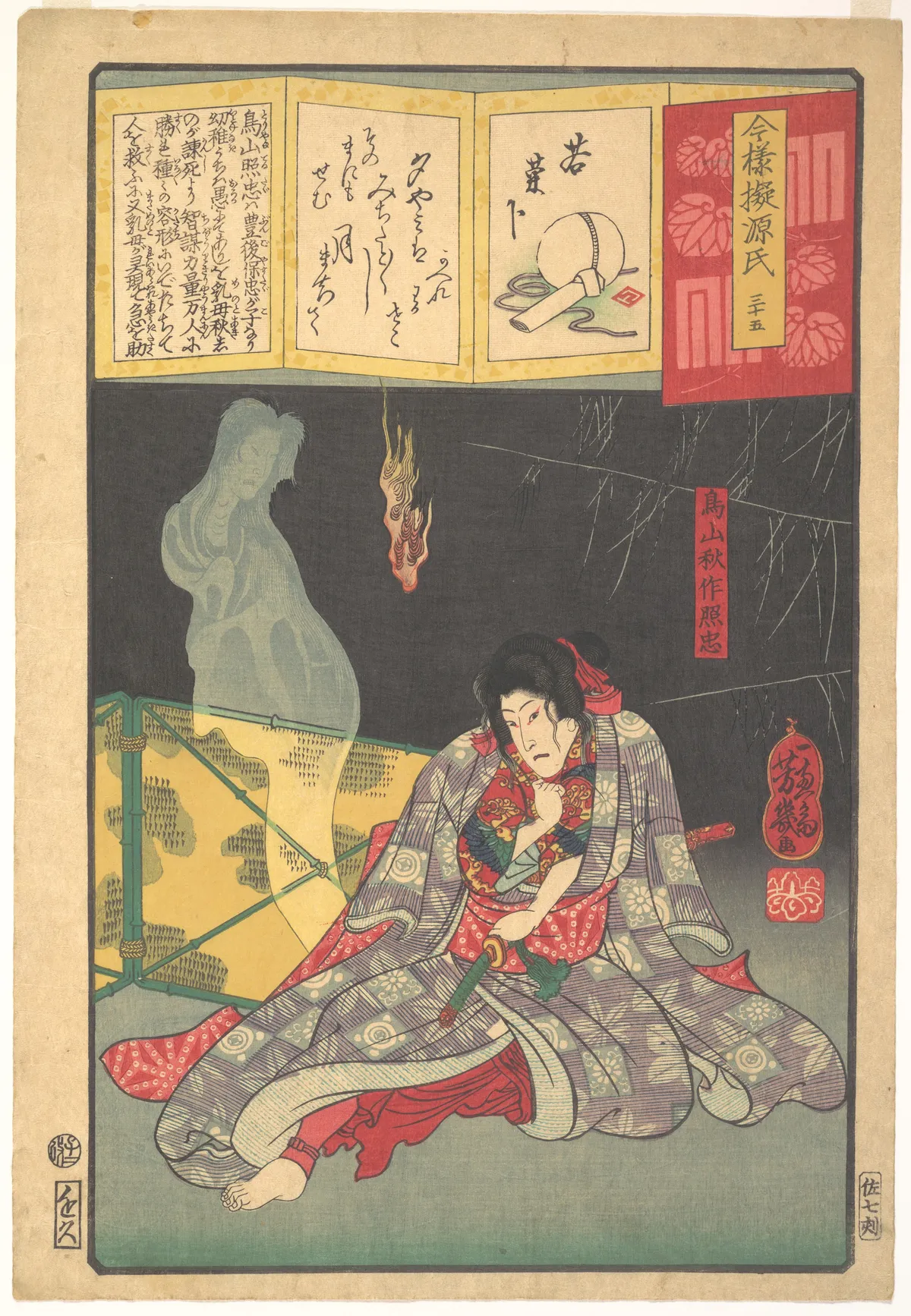
A paper door stood half open.
Some unseen lantern painted the edge of the tatami in dull gold. The woman knelt motionless, layers of violet silk pooling around her like quiet water. Her hand rested over the short blade in her lap—not to draw it, but to keep something inside herself from trembling loose.
The flame appeared first.
Not candlelight.
Something left behind by the dead.
A pale figure slowly rose beside the folding screen, hair hanging heavy as if soaked for years beneath river water. No feet touched the floor. Only a thin white haze drifted downward into the dark. The room grew colder. Even the gold leaf background seemed to lose its warmth, leaving only the silence of carved woodblock lines and fading ink.
The woman lowered her eyes.
But she already knew who had come.
Far away, beyond the alleyways of Edo, a shamisen still played somewhere in the night. One house filled with laughter. Another with sake. Another with grief that refused to die.
The ghost-fire swayed gently between them.
Like a sentence never spoken aloud.
The poems above them rustled softly against the screen. Paper whispered in the dark like teeth grinding in sleep. The woman’s fingers had turned white beneath her sleeves, yet her posture remained perfect.
A samurai daughter must not let fear loosen her collar.
She knew that if she looked up—
the face would be closer.
Closer still.
Until the breath of the dead filled the room like winter fog.
Historical Echo
This spirit-haunted ukiyo-e belongs to the late Edo fascination with kaidan — ghost stories whispered beneath dim lantern light.
By the nineteenth century, people gathered for Hyakumonogatari gatherings: one hundred tales of the supernatural. After each story, a candle was extinguished.
And when the final flame disappeared,
many believed something from the darkness would answer.
Artists such as Kuniyoshi turned those fears into woodblock prints people carried home beneath their sleeves — fragments of another world pressed into paper and ink.