The snow still hadn’t stopped.
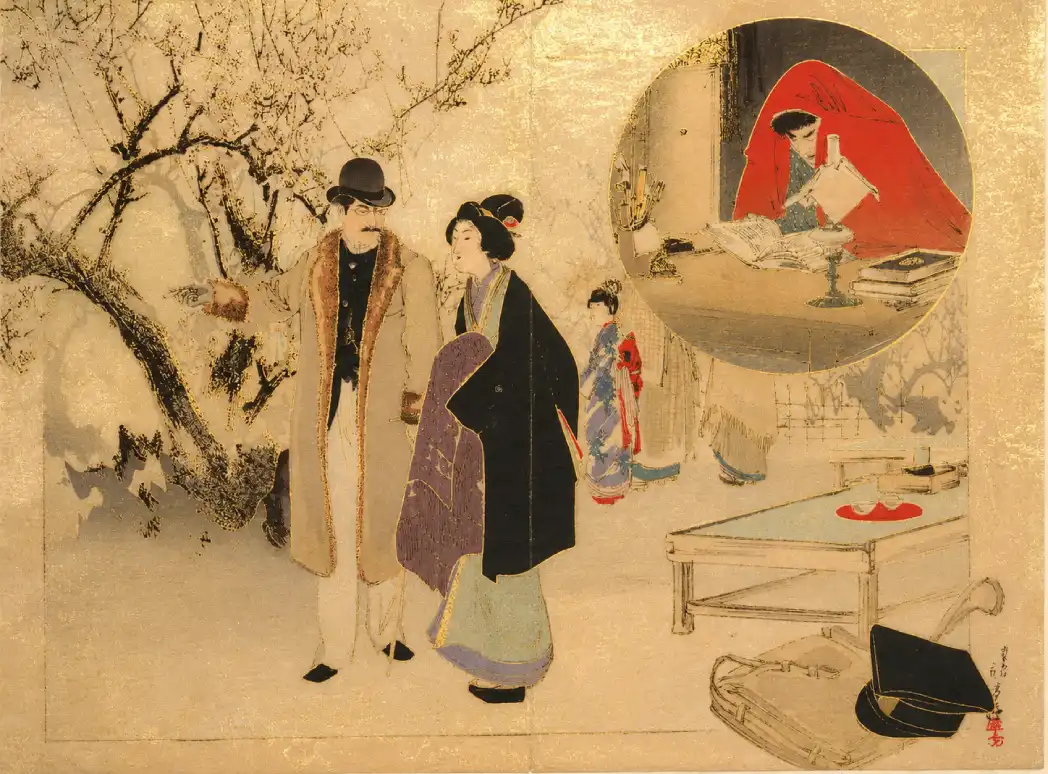
Out in the garden, the old plum tree bent under the weight of it, its branches sketching dark lines across the white ground like someone trying to write a letter with frozen fingers.
When the man stepped through the snow in his leather shoes, the sound felt wrong somehow.
Too soft.
Not the clean, dry sound of straw sandals on stone.
More like someone from another century had wandered into Edo by mistake.
The woman tightened her sleeve a little against the cold.
She didn’t look at him directly.
Instead, she watched the icicles hanging from the roof.
Inside the house, that red shawl glowed in the dim room like a quiet fire.
The woman beneath it sat frozen over her writing desk.
The oil lamp was running low, and the glass shade threw pale light across her hands. Her brush hovered over the paper for so long it almost seemed she’d forgotten how the sentence was supposed to end.
There was the smell of ink in the room.
Wet wood too.
And melting snow.
Books lay stacked neatly beside her, untouched.
Only the charcoal in the brazier cracked now and then, softly.
A tiny sound.
The kind that makes a room feel lonelier instead of quieter.
Out in the garden, the man said something under his breath.
No one heard it.
Maybe not even him.
Maybe he no longer knew whether the words belonged to Japanese, English, or just regret.
The woman smiled a little.
Not happily.
Just the sort of smile you see in old ukiyo-e prints — the kind worn by people who already know fate has made up its mind.
Far away, a steam whistle echoed through the snow.
Distant.
Almost unreal.
Like the first black ships arriving through the harbour fog, carrying a world larger than Edo itself.
And the snow kept falling.
Onto silk kimono sleeves.
Onto the brim of a Western hat.
Onto a city already beginning to disappear.
Historical Echo
Paintings like this often belong to the uneasy years between late Edo and early Meiji — when ukiyo-e artists began absorbing the strange new world arriving through Yokohama’s ports.
People started wearing Western coats over traditional kimono.
Glass lamps replaced paper lanterns.
Foreign words drifted into everyday conversation like winter wind through wooden walls.
But what unsettled people most wasn’t really the black ships.
It was the feeling that Japan had suddenly discovered the world was much bigger than it had ever imagined.