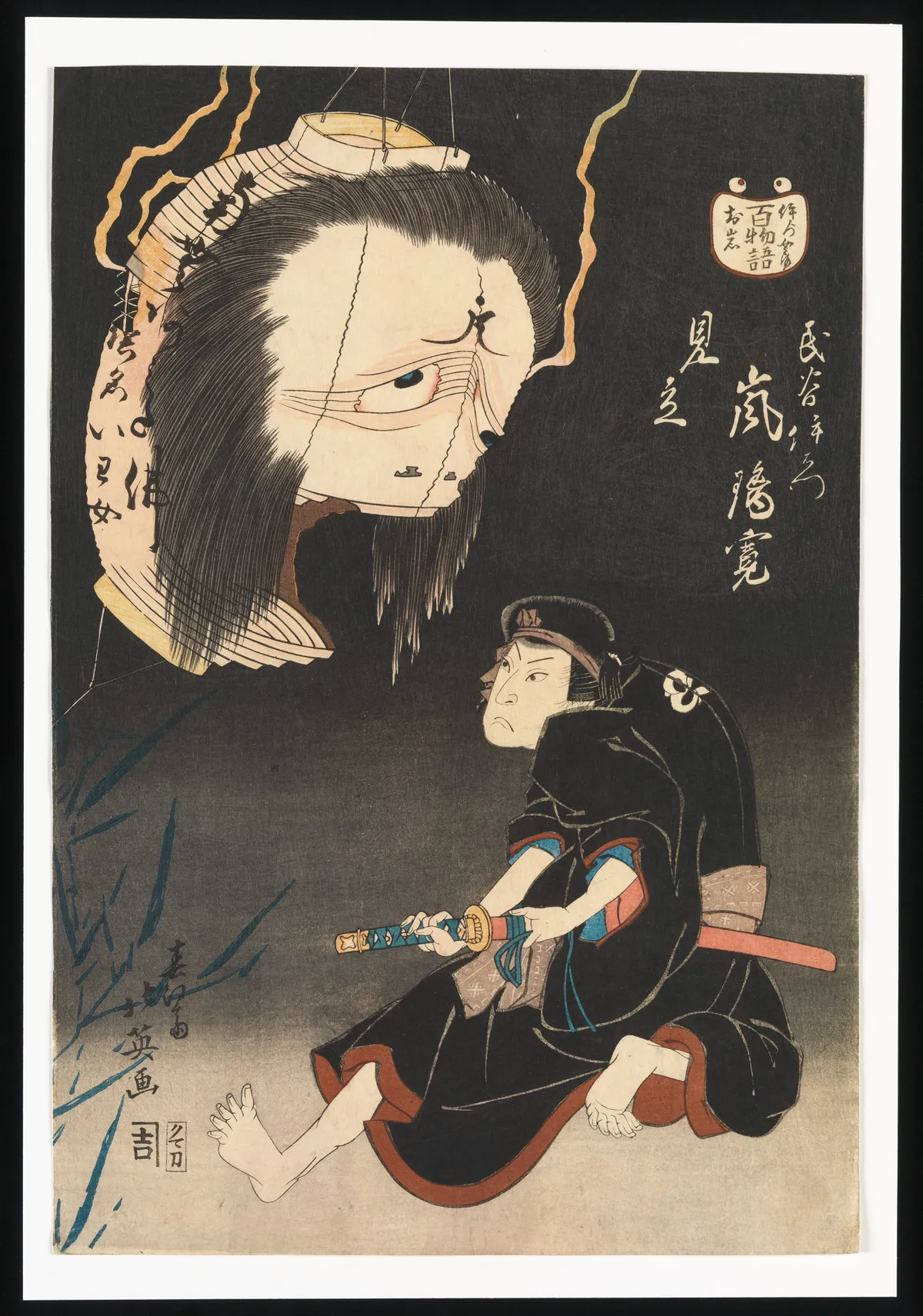
The samurai sat low to the ground, one hand resting on the sword at his waist.
Not drawn. Not yet.
Only the faint sound of steel loosening inside the scabbard.
The room smelled of damp wood, old ash, and incense that had burned out hours ago.
Somewhere beyond the paper screens, water dripped steadily into stone.
Then came the sound above him.
Not footsteps.
Rope.
A slow creaking, as though something suspended from the ceiling had begun to sway.
When he looked up, the woman’s head was already there.
No body.
Only the head.
Her hair remained perfectly arranged, dark and heavy like wet lacquer. Thin cracks crossed her pale face like splits in old porcelain. One eye drooped lower than the other, yet both remained fixed upon the man below.
Smoke curled softly from the edges of her hairline.
Not fire.
Something colder.
The samurai did not run.
People of Edo understood certain things:
The worst spirits never entered from outside.
They were born inside the house.
Inside memory.
Inside silence.
The darkness surrounding them in the print is almost empty, yet it feels crowded with unseen breath. The black background is not absence — it is waiting. Ukiyo-e masters understood how fear lived in untouched space.
This kind of apparition recalls the legends of the rokurokubi — women whose spirits wandered free from their bodies at night. Some believed they were curses. Others whispered they were souls escaping lives too narrow to endure.
The lines of the hair are carved with unbearable patience, each strand cut into the woodblock like a ritual wound. Even now, centuries later, the image still feels damp with night air.
In the late Edo period, people gathered for Hyakumonogatari — the game of one hundred ghost stories. After each tale, a candle was extinguished.
With every fading light, the room moved farther from the human world.
By the final flame, people believed something would always arrive.