The rain never fell.
Or perhaps it did once, long ago, and never truly stopped.
The darkness inside the wooden house had become wet with it. Moisture clung to the pillars, seeped into the paper doors, gathered silently in the corners where the lantern light could no longer reach. Somewhere far away, a wind bell trembled once — thin, metallic, lonely. Then even that sound disappeared.
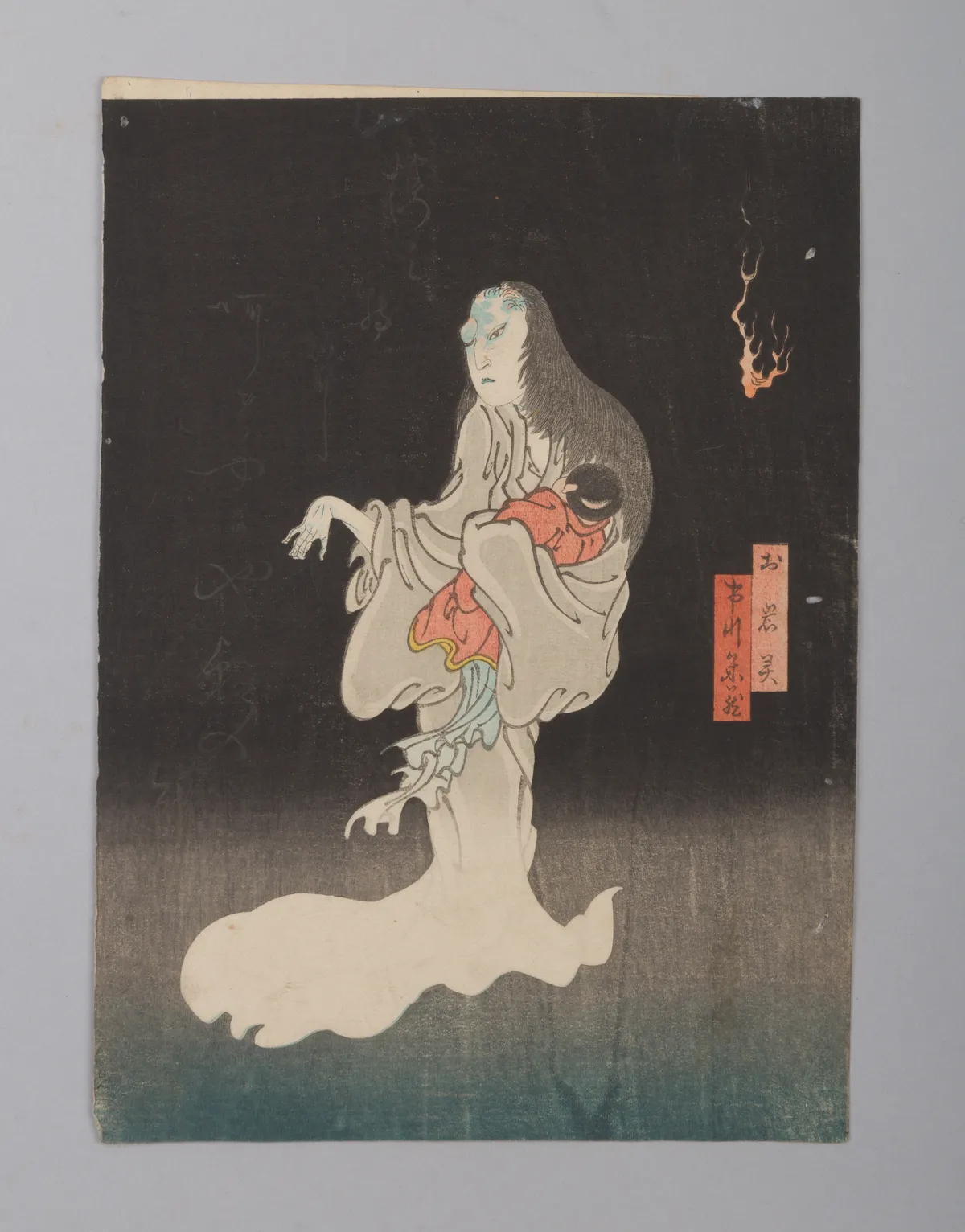
She emerged from the blackness slowly.
Not walking.
Floating.
The white robe hung too low, like cloth soaked and dragged from the bottom of a river. Her hair, heavy with dampness, clung to her shoulders in long dark strands. Yet her face remained strangely dry — pale like old ash, as though incense smoke had preserved it long after death.
The child in her arms did not cry.
That was the first terrible thing.
Children should cry in the night.
But this one rested against her silently, wrapped in red robes that still carried a trace of warmth against the endless cold around them.
Only her hand still moved.
Thin fingers. White knuckles. A gesture half-forgotten. As though somewhere inside that drifting ghost remained the memory of holding someone she once loved.
Behind her, a flame floated in the dark.
Not a lantern.
A ghost fire.
In Edo, people believed that sorrow left alone for too long could begin to glow.
If you stare long enough, you begin to notice that the lower half of her body dissolves into mist. Smoke. River water. Bone ash carried by the night air.
And still she keeps coming closer.
Without anger.
Without expression.
The truly frightening things never need expressions.
Only silence.
Only persistence.
Only the shape of love that death itself could not erase.
They say that during the late Edo period, people gathered at night for Hyakki Yagyō and Hyakumonogatari gatherings. A hundred candles were lit. After each ghost story, one flame was extinguished.
And when the final light vanished, whatever remained inside the room was no longer entirely human.
Ghost-mother prints like this became deeply beloved among the people of Edo.
Because what frightened them was never merely the monster.
It was attachment.
A mother unable to leave her child.
A soul unable to leave the world.
And the soundless moment after the lantern goes out.