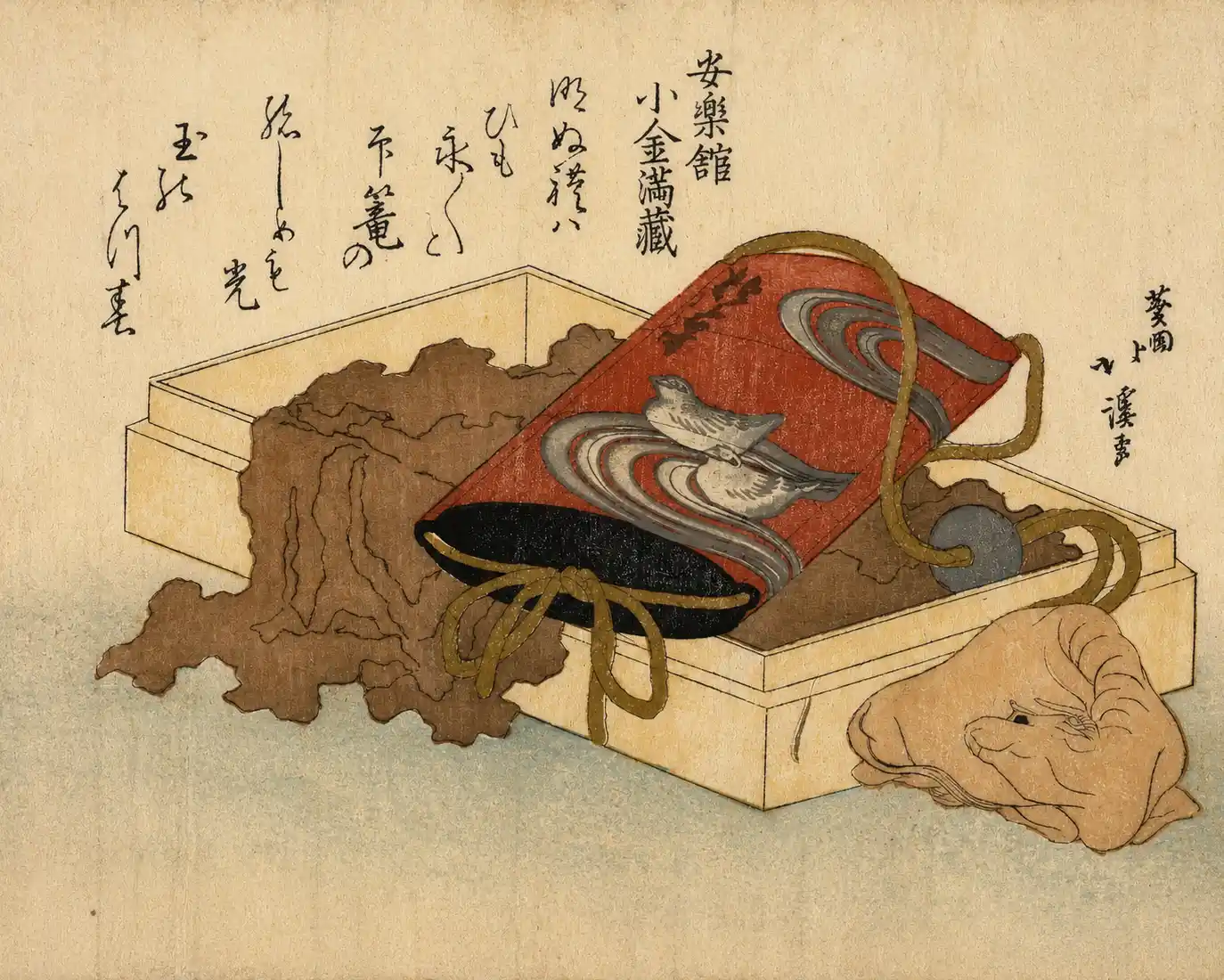
The red on the paper has already faded a little.
But the sachet still looks warm,
as if it had only just slipped from someone's sleeve.
The night is quiet.
Tatami holds the dampness of rain.
Somewhere beyond the wooden shutters,
wind moves like fingers across paper doors.
The charcoal fire is almost dead now.
Only a small red breath remains.
The woman who owned the pouch is already gone.
Or perhaps—
she never returned at all.
The sachet rests upon scattered medicinal herbs.
Its cords still carry the curve of hands
that touched them too often.
Two birds face away from one another on the fabric,
like words left unsaid.
They said a woman called Koganezō of Anrakukan
mixed incense deep into the night.
She knew how to grind aloeswood until it became softer than snow.
She also knew how to seal human feelings inside cloth.
Longing.
Jealousy.
Illness.
The memory of the dead.
Some incense, people whispered,
must never be opened during rain.
Because once fragrance touches wet air,
the dead begin remembering the road home.
At the edge of the print,
a pale shape sleeps beside the box.
Cloth perhaps.
Or an animal curled into itself.
No one would ask.
People in Edo preferred certain things unnamed.
Because once fear receives a name,
it begins to move closer.
And even now,
that small sachet still seems to wait
for the warmth of someone's hand.
***
These quiet prints appeared often during the later Edo years,
sometimes as surimono,
sometimes as small private images passed between townspeople.
No warriors.
No famous rivers.
Only the forgotten objects of ordinary nights.
Incense pouches.
Herbs.
Paper boxes.
Perfume hidden inside kimono sleeves.
But Edo people believed
the things that remain in this world are not swords—
they are scents.
In teahouses and pleasure quarters,
protective sachets were sold for love, luck, and warding away spirits.
Some hid strands of hair inside them.
Others folded secret names into paper slips.
And when the final candle went out,
all that remained in the room
was fragrance—
and attachment.