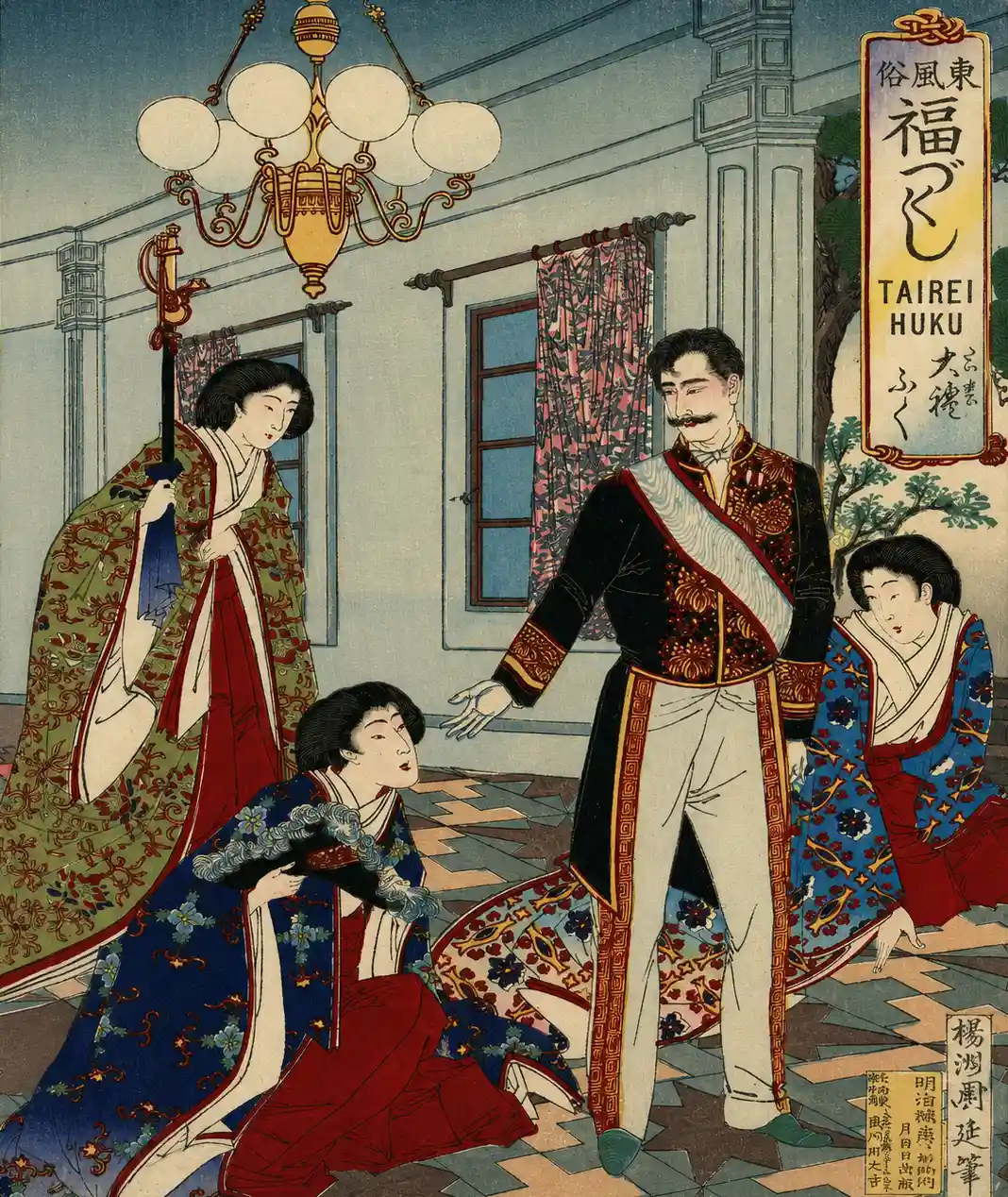
The chandelier hung above them like captive moonlight.
Inside the western-style hall, the air smelled faintly of wet timber, incense, hair oil, and foreign perfume brought ashore by unseen ships. Outside, branches moved against the windowpanes with the soft sound of rain-wind from the harbor.
The women did not look at one another.
They looked at him.
The man stood in dark military attire edged with gold embroidery, half samurai, half stranger. His gloved hand extended gently toward the room, not as an order, but as something far more dangerous—
an invitation.
Near his feet, a young woman in blue kimono held a western hat trimmed with pale feathers. Beneath the gaslight, the white powder on her face reflected a cold glow, delicate as snow floating over midnight water.
Another woman leaned quietly beside him, wrapped in crimson silk so vivid it seemed almost unreal. It was not the red of old Edo lanterns.
It was the red of a new century entering Japan.
The floor still carried the sharp geometry beloved by Edo craftsmen, yet the curtains bore foreign floral patterns from distant oceans. Somewhere beyond the walls, carriage wheels crossed wet stone roads.
For a moment, the old world and the new one occupied the same room.
And neither knew which would survive.
That was the unease hidden inside Yokohama-e.
Not merely fascination with foreigners—
but the quiet terror that the sea had opened a door that would never close again.
So the printmaker carved the scene into wood.
Because even fleeting moments deserve witnesses.
Especially the moments when an entire civilization begins to change its face.