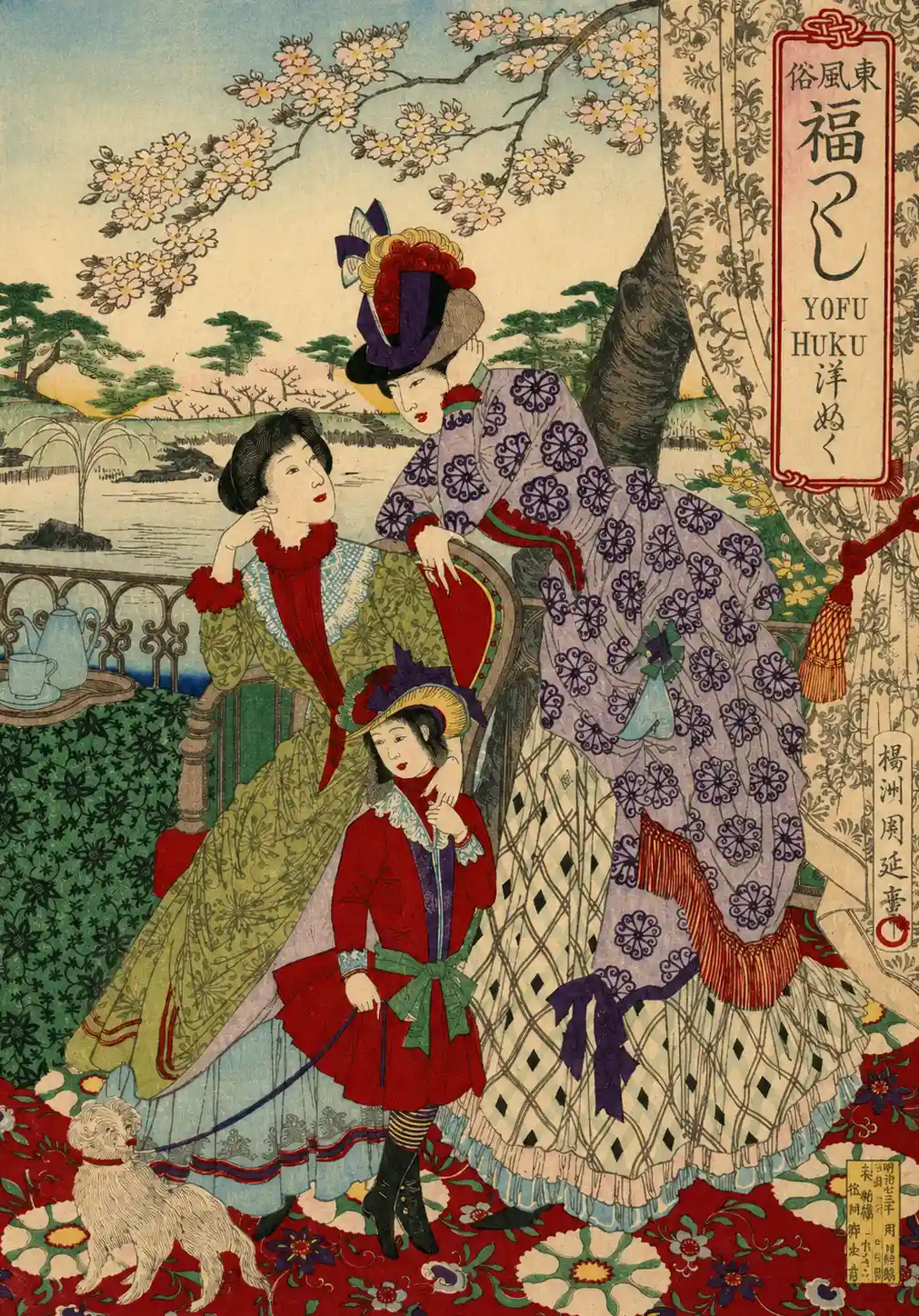
The wind arriving from the sea carried a scent that did not belong to Edo anymore.
Even the cherry blossoms seemed uncertain beneath it.
The women rested beside an iron Western chair, their layered dresses spreading across the carpet like waves learning a new language. Crimson patterns bloomed under their feet — too rich, too foreign — as though Yokohama itself had unfolded inside the room.
The woman in violet leaned closer, ribbons trembling beside her cheek.
Yet her eyes were not truly on her companion.
Somewhere beyond the quiet pond,
beyond the pine trees,
beyond the pale spring haze—
black ships were waiting.
The women of Japan had begun to wear corsets, hats, imported fabrics, unfamiliar perfumes. But they still lowered their eyes when speaking. They still carried silence inside their sleeves like hidden incense smoke.
The child stood between two centuries,
holding a small white dog by a thin leash.
Her boots pressed awkwardly into the floral carpet. The dog sniffed the air, where coal smoke, seawater, machine oil, wet timber, and foreign perfume drifted together beneath the blossoms.
Only the cherry branch remained unchanged.
It stretched over them exactly as it had for generations.
The flowers did not yet know
the country beneath them was already changing.
In Yokohama nights,
many people stopped sleeping.
Some studied English by lantern light.
Some cut away the topknots of samurai bloodlines.
Some saw steamships for the first time.
And some discovered fear for the very first time—
because the world beyond the sea
was real.
And the quietest people
were always the first
to hear history cracking open.
***
Preserve the original ukiyo-e composition and linework,
high fidelity Edo-period ukiyo-e restoration,
authentic Yokohama-e restoration,
aged washi paper texture,
visible woodblock grain,
natural ink bleed,
hand-carved printing imperfections,
soft mineral pigments,
subtle Japanese antique coloration,
cinematic atmospheric lighting,
deep shadow layering,
authentic Edo-era aesthetic,
museum-quality restoration,
ultra detailed,
black ships atmosphere,
western technology shock,
harbor fog,
civilization anxiety,
early modern Japan atmosphere,
silk and wool textile texture,
Meiji transition melancholy,
faint sea humidity,
foreign perfume atmosphere,
quiet spring sunset,
NOT modern anime,
NOT digital painting,
NOT glossy CG,
NOT photorealistic skin,
NOT oversaturated colors,
NOT plastic texture,
NOT western fantasy,
NOT cartoon style,
NOT sharp AI rendering