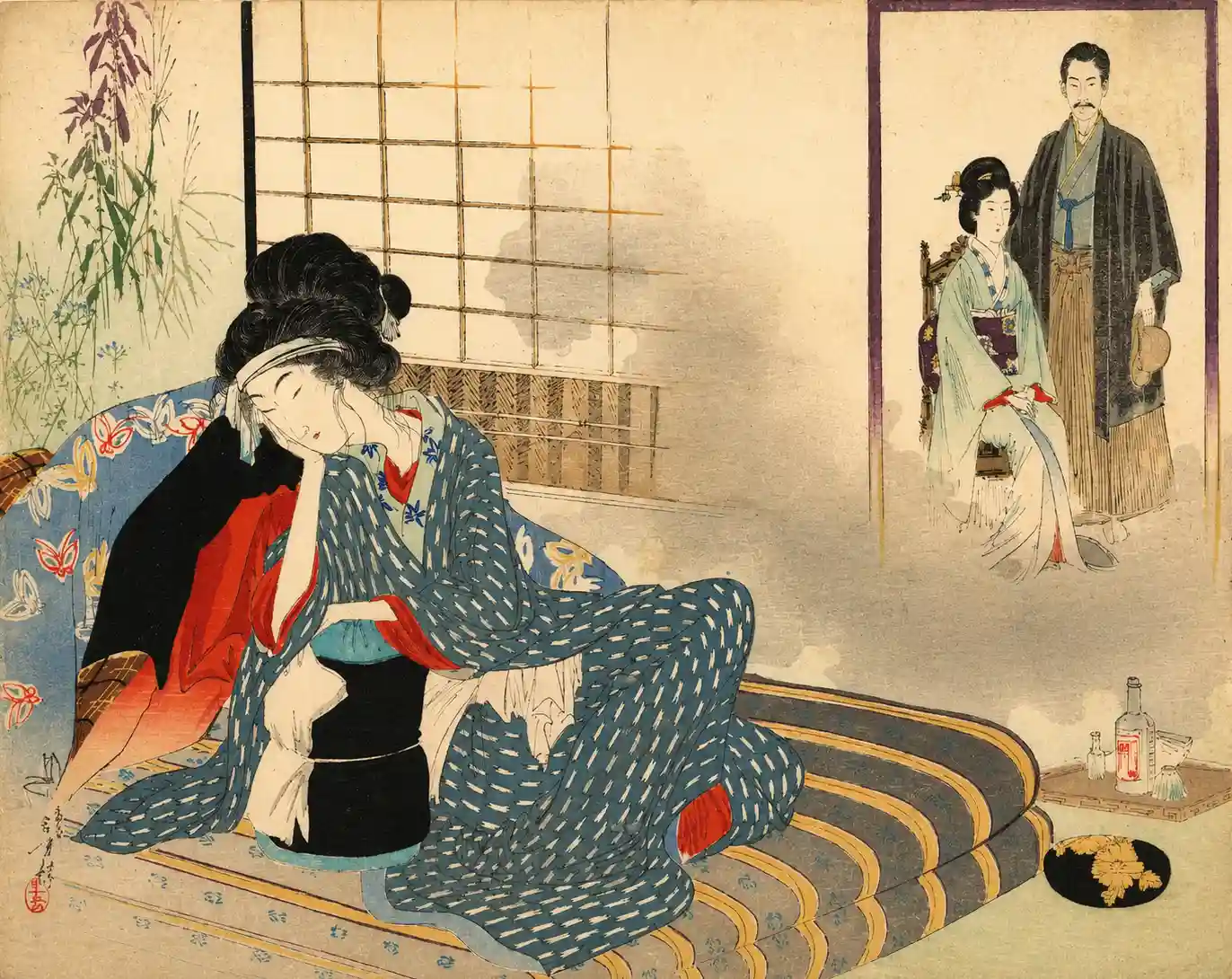
The shoji was never fully closed.
Night wind slipped through the bamboo shadows and touched the flame until the room began to breathe unevenly.
She leaned against the bedding as if sleep had abandoned her many evenings ago.
The indigo kimono folded around her like slow water. White dash patterns drifted across the cloth like rain moving over a dark river. One pale hand held her forehead gently, not in pain alone, but in exhaustion too old to explain.
The charcoal fire was nearly dead.
Medicine lingered in the air.
So did perfume.
On the wall, the lantern cast trembling shadows that looked almost human. Near the corner sat a glass bottle beside a black lacquer basin filled with unmoving water. Everything inside the room felt damp with silence.
She never looked directly at the portrait.
Yet she could feel it watching.
The man stood upright beside the seated woman, both dressed in the careful dignity people reserved for photographs. Faces prepared for memory. Faces prepared for disappearance.
Only midnight returns the truth to a person.
Somewhere outside, wooden sandals crossed wet stone.
A pause.
Then nothing.
The footsteps never came closer.
Rain gathered softly behind the paper screens, and the room drifted deeper into that strange loneliness only old Japanese nights seem to carry. Her eyes remained closed, as though waiting for someone she already knew would never arrive.
Incense ash collapsed in silence.
The hour grew darker.
And in old Japan, many women became invisible long before they became old.
***
Late ukiyo-e and shin-hanga often carried a quiet sadness beneath their beauty.
After Meiji, Japan gained photography, western medicine, electric lamps, and modern cities — yet the heart did not become lighter.
The women in these prints were no longer only courtesans meant to be admired.
They became human beings.
Women who grew tired.
Women who waited.
Women who listened to rain while wondering what remained of themselves.
It is said that Tokyo rain in those years lasted for days.
Many artists became fascinated by dim lantern light swallowed by moisture and shadow.
Because loneliness sharpens the outline of a soul.