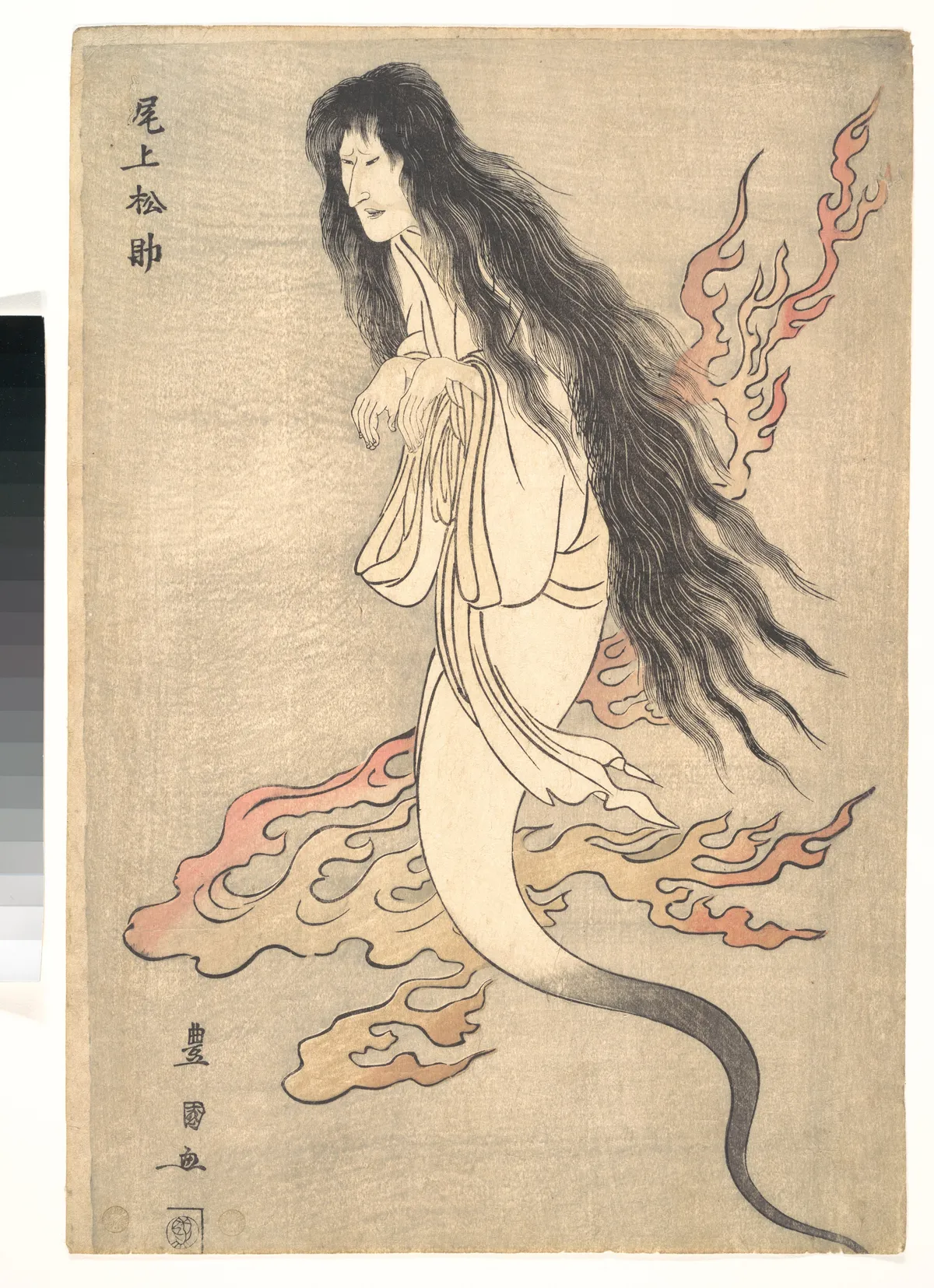
She rises slowly from the fire, tail first touching the ground.
Not a snake.
Something that still remembers being human.
Her hair hangs heavy, soaked in the darkness of a hundred wells, drifting at the edges like wet silk beneath midnight wind.
The flames do not burn her.
They follow her.
Her head remains lowered, as though listening to a sliding wooden door somewhere far away in Edo.
Her wrists droop softly.
Even now her fingers still carry the memory of ordinary gestures—
straightening a kimono collar, tending incense, extinguishing the final light before sleep.
But she no longer remembers how long she has been dead.
The paper has yellowed with age.
The carved lines remain delicate.
Around her there is almost nothing.
Ukiyo-e ghosts are often painted this way.
Because what frightened people in Edo was never truly the yokai itself.
It was the emptiness surrounding it.
The terrible thought that one night,
you too might quietly become part of the picture.
The flames gather behind her like breathing.
The cracks of old washi paper resemble rotting wood in an abandoned shrine.
If one could lean close enough, perhaps there would still be the scent of damp tatami, burnt oil, and an old household altar lingering beneath the ink.
She is not here to haunt anyone.
She simply never found the way to leave.
***
This image belongs to the world of Edo-period yokai prints — where long black hair, spectral fire, and vast negative space create unease more effectively than violence ever could. The supernatural in ukiyo-e is rarely loud; it lingers like memory trapped inside paper.
It was said that during the Hyakki Yagyō tales of late Edo nights, people gathered to tell one hundred ghost stories by candlelight.
After each story, another flame was extinguished.
And when the final light disappeared—
if the room suddenly became silent,
it meant something else had already joined the gathering.