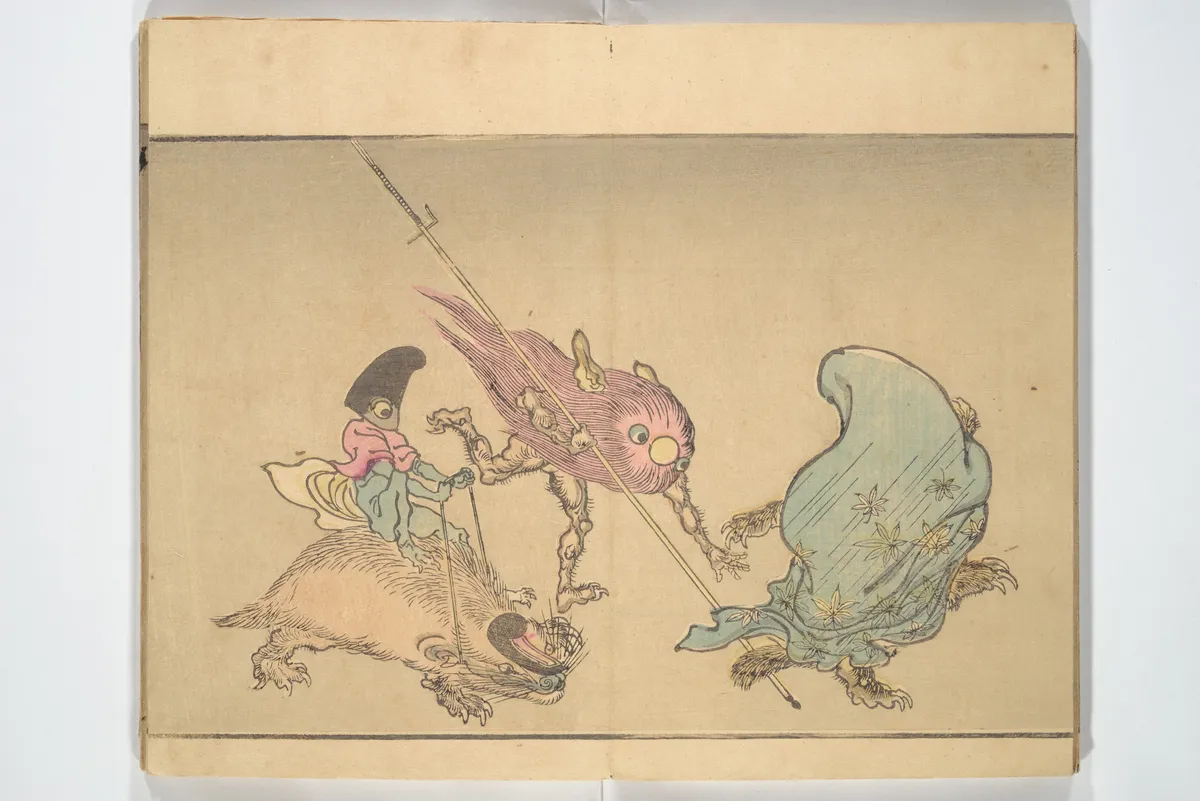
The pink creature crawled along the shaft of the spear as though it had slipped out from a chimney fire. It barely possessed a face—only eyes pressed into existence by human fear itself. Its fur streamed backward like burned silk, its thin fingers reaching toward the blue-draped figure ahead.
That thing did not turn around.
It simply dragged its cloth-covered body deeper into silence.
Beneath the robe, however, were not human feet.
But claws.
On the left, a beast crouched low against the empty ground, nose nearly touching the earth. Upon its back sat a tiny figure in strange garments, absurd at first glance, yet drained of all humor beneath the pale stillness of the scene. The spear cuts diagonally across the composition, pinning all three apparitions inside the same breathless moment.
There is no landscape.
No house.
No moonlit river.
Only emptiness.
That is often how Edo-period yōkai prints work.
The terrifying thing does not emerge from distant mountains.
It appears suddenly inside blank space.
The fold running faintly through the paper feels almost human, as though someone once carried this print hidden inside their robe for years. The woodblock lines still tremble slightly with the hand of the carver. The pigments are muted, softened by mineral dust and age. The blue robe bleeds gently into the fibers of the washi paper like moisture spreading through old walls during a rainy season.
Late at night, the people of Edo gathered to play Hyakki Yagyō tales and ghost games.
One candle was extinguished after every story.
And when the final flame disappeared—
the real things were said to arrive.
These images were never painted merely to frighten.
They existed because people already knew something darker:
that certain creatures do not live in forests or abandoned temples.
They wait quietly inside the human heart.
***
By the late Edo period, yōkai had begun drifting away from pure religious terror and into the world of popular entertainment.
Ghost books, night stories, kabuki spectacles, and woodblock prints carried strange beings into the homes of ordinary townspeople. Fear slowly mixed with fascination.
Artists no longer painted monsters simply as evil spirits.
They painted anxiety itself.
And perhaps that is why these old ukiyo-e creatures still feel alive today.
Because even now, beneath electric light and modern streets, people remain afraid of the same thing the Edo townsfolk feared in silence—
the moment the darkness begins to resemble their own thoughts.